
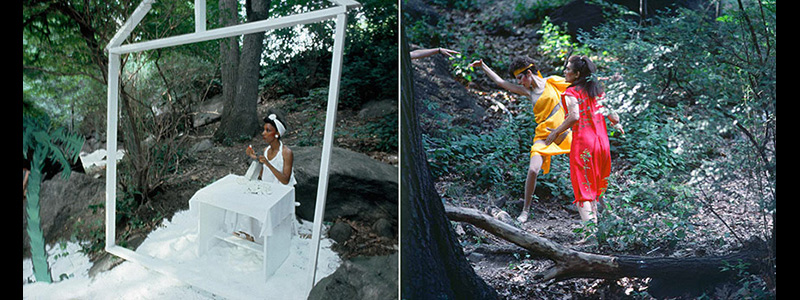
Rivers, First Draft, or The Woman in Red
performance 1982
Rivers, First Draft was a one-time only performance created by O’Grady for “Art Across the Park,” curated by Gilbert Coker and Horace Brockington. It was performed in the Loch, a northern section of Central Park, on August 18, 1982 and was a “collage-in-space,” with different actions taking place simultaneously on two sides of the stream and further up the hill. The narratives that competed for attention were about uniting two different heritages, the Caribbean and New England, and three different ages and aspects of the self, a young girl, a teenager, and an adult woman. It was a three-ring circus of movement and sound that, unlike the random-ness of Futurists attempting to shout each other down, played more like a unitary dream.
The emotional effect of Rivers, First Draft was more positive and hopeful than that of O’Grady’s previous performance, Nefertiti/Devonia Evangeline, which was about failure to effect reconciliation with the dead, even about failure to perform, with its final image of the artist trying but being unable to straddle two tubs of sand. The pivotal moment of Rivers, First Draft occurs after the Woman in Red has been ejected by the Black Male Artists from their closed studio: she descends to the stream bank where she sees a white stove and claims it by painting it red. O’Grady’s most personal and feminist piece to date, the performance ends in an image of acceptance and reconciliation as the Little Girl in a Pink Sash, the Teenager in Magenta, and the Woman in Red help each other exit down the Loch stream. Perhaps not so contradictorily, the figures are actively guided by the male New England figure, the Nantucket Memorial statue, while the female Caribbean figure, the Woman in White, continues to endlessly grate coconut, calmly indifferent to the scene unfolding below.
The performance was seen by a small invited audience, mostly friends from Just Above Midtown, and occasional pedestrians walking through the seldom visited Loch.
Rivers and Just Above Midtown, 2013, 2015
© Lorraine O’Grady, “Rivers and Just Above Midtown,” Lorraine O’Grady, Alexander Gray Associates, NY, 2015. Exhibition catalogue.
A meditation on why Rivers, First Draft might not have existed without the Just Above Midtown Gallery’s challenging and supportive environment. Text first read at MOMA’s “Now Dig This!” symposium, 2013.
****
Intro
The Rivers, First Draft installation consists of photos from a performance done in Central Park as part of “Art Across the Park” in Summer 1982. Together, the curator and I made an exhausting tour of the Park to look at suitable locations.
When she and I reached The Loch, a little-known section at the Park’s northern edge, it captured me. This wasn’t the Frederic Law Olmsted I thought I knew. It was wild and frighteningly unkempt, like something out of literature, not the city. And it was perfect for the piece I needed to create.
Rivers would be a one-time only event with a cast and crew of 20, several of whom, including a young Fred Wilson and the late George Mingo, were part of Just Above Midtown, the black avant-garde gallery I was associated with then. The piece would be performed for an invited audience barely twice as large as the cast, no more than 40 people, nearly all with JAM or part of its environment. And there was an uninvited audience of about five passers-by who’d come on the scene accidentally and stayed. One, a young Puerto Rican taking a short-cut from the pool where he worked as a lifeguard, said afterward it was like walking into one of his dreams.
The piece was a narrative three-ring circus, about a woman trying to become an artist. In it, her present and past happen simultaneously.
It was called Rivers, First Draft because it was done quickly and I knew I would have to go back to it. It was always meant to be the first of a three-part piece called Indivisible Landscapes: Rivers, Caves, Deserts. But perhaps when I revisit it, it will be unrecognizable. For me now, the making of Rivers and what it uncovered was one of the most important moments of my artistic and personal life and could not have happened without Just Above Midtown, a nurturing space when others would not have us.
For me, doing Rivers in the context of Just Above Midtown was a unique art-making moment, one when the enabling audience—the audience which allows the work to come into existence and to which the work speaks—and the audience that consumes the work were one and the same.
The installation here is silent on the wall or on pages in a catalogue, titles newly added. Imagine my voice reading a text which bears on it only tangentially. (….)
Email Q & A w Courtney Baker (RFD), 1998
Lorraine O’Grady Interview by Courtney Baker, Ph.D. candidate, Literature Program, Duke University.
Unpublished email exchange, 1998
The most comprehensive and focused interview of O’Grady to date, this Q & A by a Duke University doctoral candidate benefited from the slowness of the email format, the African American feminist scholar’s deep familiarity with O’Grady’s work, and their personal friendship.
****
In November 1998, Courtney Baker interviewed O’Grady for a paper for a performance class with Kristine Stiles at Duke. The Stiles paper was to be the first of two papers: the second, for a symposium the following semester, would address O’Grady’s more recent work. The current paper would contain basic research for the second and be limited to older work.
Baker: As a set up, the two pieces I want to focus on are Mlle Bourgeoise Noire and Nefertiti/Devonia Evangeline, mostly because there is more written on those pieces and I feel I have a better handle on them. Do you think this is okay, or am I remiss in leaving out some of your other performance work?
O’Grady: I understand why you’d know more about those two. Art Is. . ., the parade piece I did in Harlem, was intentionally less well known as I did it basically outside the art world. But Rivers, First Draft, a kind of “three ring” performance in Central Park, which only those who were there were able to see, has become more interesting to me as I look back. It’s the most “feminist” piece I ever did. I know you minored in women’s studies, and you might like to take a look at what’s left of it, some photographs and a script.
In Rivers, First Draft, there is a moment where—after playing around in the castle (up the hill), then leaving to find herself and her place; and after being raped by the Debauchees on her way down the hill—the Woman in Red goes into the Black Artists’ room (a door placed on the hill, behind which three black male artists are standing and crouching). But when the Woman in Red enters, the black male artists toss her around and throw her out summarily and roughly. She looks around dazed, then instinctively descends further down the hill, still trying to find her way. There’s a white stove at the bottom which, to her, echoes her mother’s white kitchen on the other side of the stream. She paints it red in an attempt to make it her own.
These actions are a not-so-metaphoric description of what happened to me autobiographically: drifting in the losing battle to please unpleasable parents (the way abused kids do, because they have no perspective, see no alternative), then partying absently, without a self—nobody home. After a while (a long while), if you have any brains at all, you can see the emptiness of it, can tell that with your inevitably diminishing looks, you’ve crossed over from using to being used. You go in search of your self. There are missteps along the way. If you’re a woman, there’s always the temptation to play the men’s game, by their rules.
At the time of the performance, I was still involved with Just Above Midtown. The gallery was dominated by what we “girls” used to call the “locker room boys”—David Hammons, Houston Conwill, etc., etc. A few of those guys actually played the “Black Artists” in the performance: George Mingo, Noah Jemison, and Lorenzo Pace. At JAM, the attitudes of the men were like those in the civil rights movement: women’s place was prone or, at least, not talking too much, and if possible, typing out grant applications for them. Above all, women artists weren’t supposed to be too successful, too good. When the JAM crowd came to the performance in the park, it was the moment where the Black Artists threw me out that they found most shocking, some told me later. I was saying what I thought, and they weren’t used to that. ( . . . )
Black Dreams (RFD), 1982
“Black Dreams.” Essay, in Heresies #15: Racism Is the Issue, n.d., pp. 42-43.
© Lorraine O’Grady, 1982
Published in the Heresies collective’s journal, this was O’Grady’s first attempt to deal publicly with issues of black female subjectivity. It is based firmly in personal anecdote and psychological description rather than the more theoretical analysis she would later employ.
****
“Which would you guess was the biggest category?” I asked as I handed my new black woman therapist the organization chart I’d made of nine months’ worth of dreams.
I’d finally located her in September. Even in New York it hadn’t been easy. Only one percent of the therapists in America are black, and I’d spent July and August going to one white therapist after another who’d ask the standard question: “Why have you come into therapy?” When I was too embarrassed to answer directly, they’d accused me of being an aesthete, of wanting to take a symbolic journey into self-discovery.
There was the estrangement from my son, of course. But even if I’d been able to talk about it. I couldn’t have placed it in its deepest perspective by describing the specter standing behind not just my problems with motherhood, but those with my family, sex, and my artistic persona. With these male and female therapists I couldn’t break out of the defense I’d adopted toward the whole white world, the mystique that everything was all right, that I had no racial problems. Even when I trusted their capacity for empathy, I couldn’t talk to them about the subtle identity problems of a fair-skinned black woman, born and raised in Boston at a time when “social” blacks (the families who sent their children to Ivy League Schools) were still trying to be white.
Meanwhile, shopping for a therapist was becoming expensive. Jung had said that series of dreams were far more informative than dreams taken singly, and since I’d begun collecting my dreams at the beginning of the year, I now had nearly 150. To save time and money I decided to organize them. At the end of August, after saying goodbye to my last white therapist, I took my journal to Martha’s Vineyard and arranged the dreams into 24 categories with names like Upstairs/Balconies and Downstairs/Basements, Papa, Mama, Devonia (my sister), Sex, Art, Fear of Ending Up Alone, and Blacks/Racial Attitudes.
The results were startling. The Blacks/Racial Attitudes series was the largest, with roughly 30 dreams containing the motif, 10 more than the next largest series. I knew I’d been kidding myself, as well as white people, about the extent of my problem, but seeing it statistically tabulated like this unnerved me.
The black woman therapist, Vassar-educated and 10 years older than me, looked over the list. “I don’t want to guess which category contains the most dreams, Lorraine, because I don’t know you. But,” she hesitated, “experience would lead me to. . . could it be Blacks/Racial Attitudes?”
On Thursday, August 20, I was feeling depressed about Reagan, and paranoid about the fascism lying in wait just below the surface of the country. In my worst-case fantasies, the dragon breaks out and, as in Nazi Germany, gobbles up those closest at hand: assimilated blacks first.
That afternoon I wrote in my art journal a proposal for an installation to be called Walter Benjamin Memorial Piece (A Black Intellectual Gets Ready in Time), with a wall plaque containing the following quote:
On September 26, 1940, Walter Benjamin, who was about to emigrate to America, took his life at the Franco-Spanish border. The Gestapo had confiscated his Paris apartment, which contained his library (he had been able to get “the more important half” out of Germany) and many of his manuscripts. How was he to live without a library? How could he earn a living without the extensive collection of quotations and excerpts among his manuscripts? [Hannah Arendt]
Mounted on three dry walls was to be a life-sized photo reproduction of my library alcove (the shelves contain about 3,000 volumes). In the center of the alcove, my actual desk, extremely cluttered, a typing table and chair, and scattered about on the floor, a jumble of packing crates with labels not yet filled in.
That night I had the following black dreams. I made the journal responses a couple of months later and gave them, together with the dreams, to the black woman psychiatrist. ( … )
Performance Statement #2 (RFD), 1982
“Performance Statement #2: Why Judson Memorial? or, Thoughts about the spiritual attitudes of my work.” Unpublished.
© Lorraine O’Grady 1982
In writing a proposal to perform Rivers at Judson Memorial Church, a venue with important avant-garde history, O’Grady unexpectedly reached greater clarity on the spiritual aspects of her work, especially its forms.
****
I have purely performance reasons for wanting to do RIVERS at Judson Memorial. The first is my feeling that RIVERS is important, ambitious work which should play in a significant space. A more practical reason is the spatial requirement of the piece itself. RIVERS is designed on the ancient theme of The Crossroads (particularly important in Haitian Voudoun). It needs an upper and lower playing level, so the piece can develop on a visual vertical while, at the same time, having a horizontal line that clearly divides “above” from “below.” The raised altar of Judson’s sanctuary would provide this. In addition, the piece’s deliberately tempestuous soundtrack demands good acoustics. Though not perfect, Judson would work well.
Another reason for my choice of Judson has to do with the content of the piece. Although the work for which I’ve become known is heavily political, throughout all of it there has been an underpinning of religious concern — as in the funeral ritual of Nefertiti/Devonia Evangeline, or the water symbolism and hymn singing of Rivers, First Draft. Sometimes the religious concern disappears into the purely aesthetic — for instance, the chasuble-like design of Mlle Bourgeoise Noire’s cape. As a child of Jamaican immigrants, I was raised an Anglo-Catholic, or High Episcopalian, and I have been permanently influenced by the church’s attitude toward ritual and form.
The “religious attitude” is an involuntary aspect of my mental landscape. I’ve long since renounced the church, but my life an work are marked by a quest for “wholeness,” a variant, I guess, of the old spiritual search for significance in the cosmos. As a good post-modernist, I undertake the quest for “wholeness” and “meaning” knowing that it’s doomed. But I can’t help harboring a secret hope that I will be able to achieve psychological and artistic unity. The predominant aesthetic of my work is that of collage,, i.e. of disparate realities colliding, of fragmentation and multiple points of view (I teach a course in Futurism, Dada, and Surrealism at SVA), but with me, the collage aesthetic reflects a desire to unify and contain everything. It isn’t intended to be merely descriptive; it is never a capitulation to the fragmentation and division.
The governing aim of my work is the reconciliation of opposites, and my subject matter often deals with this explicitly, as in the reconciliation between past and present in Nefertiti/Devonia Evangeline; between the West Indies and New England in Rivers, First Draft; and between aspects of the divided self in The Dual Soul and Indivisible Landscapes. In the work’s form as well, I try to create work that is both abstract and concrete, which is to say, both formally beautiful and capable of delivering specific intellectual and political content. I try to find formal ways to combine an obsession with autobiography and the inner life of dream and myth with my attitude of political intransigence (you might say I am both a Jungian and a Marxist in my fashion). But the work proceeds in this direction only awkwardly: I am aiming for the “perfect balance” between personal and political, abstract and concrete, and whenever the work is too heavily weighted toward one or the other — which it most often is — I feel that I have failed. But I keep trying to juggle all of these elements.
Although I hope to make RIVERS a much less personal and a more political piece than was Rivers, First Draft, at the same time, my main reason for wanting to perform it at Judson Memorial is my even greater desire to have both the personal and political content of the piece interact so strongly with the religious nature of the church’s space that they will produce a result larger than either the personal or the political.
Rivers, First Draft, 1982
“Rivers, First Draft: working script, cast list, production credits.” Unpublished.
© Lorraine O’Grady 1982
O’Grady’s most autobiographical performance was a “three-ring” simultaneous narrative performed one time only in the Loch section of Central Park on August 18 for “Art Across the Park,” curated by Gilbert Coker and Horace Brockington. This script, redrafted until the day of performance, and a set of photo-documents are the only remains.
========================================
STILL IMAGES (SILENT)
1. The Woman in the White Kitchen
On the near bank of the stream, there is a house frame of 2 x 4’s painted enamel white. It is of the front of the house only and has no wall.
On the ground, in front of the frame and extending inside the “house,” is a bed of white pebbles forming a square white garden. It flows from under the kitchen furniture which consists of a white stool and miniature white table.
A brown-skinned woman wearing a white halter dress and white wedgies, with a 40s hair style (pompadour type) and bright red lipstick, sits at the table preparing white food — either grating coconut, or flaking codfish and mixing it with chopped onion and flour.
In front of the house frame is an artificial potted plant: it is a fir-palm (the combination hybrid of a fir and a palm) and seems to be a metaphor for the West Indian transplanted to New England.
In the kitchen, a short-wave radio tuned to a New York station (WLIB) blasts a 5-minute newscast delivered in a West Indian accent. The broadcast has been creatively taped by selecting out the most pompous statements, the most stereotypically eager to appear sophisticated and American, and repeating them.
The image that the Woman-in-White projects with her repetitive grating, flaking, chopping, or sifting actions is that of a perfectionist, not one who is tight and determined, but more relaxed — her perfectionism seems less an inner need to be perfect than a need to appear perfect to the alien world in which she now lives.
Her activity continues uninterrupted throughout the entire performance, from just before the start of the West Indian newscast until after the procession goes down the stream at the end.
2. The Nantucket Memorial
A statuary complex reminiscent of New England granite. One or two men, in nor’easters, slickers and fishermen’s boots, enter the stream at the same time the Woman-in-White sits down at her kitchen table. They wear a rowboat structure suspended from their bodies in such a way as to leave their hands free. On the side facing the audience, the boat is painted with the words “NANTUCKET MEMORIAL.” The whaler(s) stand still as statues in the boat, hands resting on its frame. The whole image, men and boat, is colored granite grey.
The stone whaler(s) are positioned at the far end of the stream, standing perfectly still all the while, until the next-to-last scene. They should look and feel (and be ignored) like statues that are part of the park landscape, ultimately blending in ( … )
Paris Review, 2016
Caille Millner, “Rivers, First Draft: Lorraine O’Grady’s living Künstlerroman.” Paris Review. January 13, 2016.
In 1982, the artist Lorraine O’Grady staged her first major performance piece in Central Park, “Rivers, First Draft.” In the park’s bucolic Loch section, the audience watched a black woman in a red dress walk down the ravine. Red is a sign for wanton women, and this one was in the company of wild-eyed dancers, barely clothed—all of them white. She was shy, lingering behind the dancers as they shimmied and shook down the hill. When she caught up and tried to engage them, they spurned her.
So the woman in red wandered over to a door. Several black male artists were gathered behind it. She knocked, and they, too, turned her away. While she hesitated, hoping to change their minds, the dancers returned and attacked her with Dionysian energy.
It doesn’t take an academic to find the narrative: her heroine’s layers of gender and racial difference—what today we might call her intersectionality—was affecting her ability to find an artistic community. There was a sly bitterness in the fact that O’Grady staged her heroine’s rejections with the kinds of New York cliques that liked to advertise how inclusive they were. Her staging suggested that real life wasn’t that simple. In this context, her heroine’s red dress was less a marker of her actual behavior and more a sign of the social threat she represented.
O’Grady has described the piece as her most personal. It’s also, in its way, instructional: a kind of Künstlerroman, it’s one of the clearest how-to guides for women of color on how to become artists. In the hands of a lesser artist, the attack is the moment when “Rivers” would start to fall apart—to get bogged in the muck of identity politics. Instead, O’Grady showed a way out. Her woman in red escaped the dancers and ran from the male artists’ door. When she was alone again, she considered the final object in front of her. It was a stove: a classic totem of female entrapment. Calmly, she took up a can of spray paint.
In 1980s New York City, the spray can was a sign, too—of defiance, demand. The woman shot paint at the stove until it was as red as her dress. Only when they wore the same color did she stand before it to cook—to begin, that is, creating her own work.
For the woman in red and her audience, that moment at the stove was every bit as defining as Stephen Dedalus’s epiphany in A Portrait of the Artist as a Young Man: “He was destined to learn his own wisdom apart from others or to learn the wisdom of others himself wandering among the snares of the world.” The first incidence of artistic transformation is a crucial moment in every Künstlerroman. What’s significant about “Rivers” is that it was addressed to a group, young black women, that’s historically had few of them. (…)
New York Times, 2015
Holland Cotter, “Review: Lorraine O’Grady’s Gift for Language and Images.” New York Times, June 25, 2015
Cotter’s review of O’Grady’s exhibit at Alexander Gray focuses on her use of collage in both “Cutting Out the New York Times” and “Rivers, First Draft” as a method of shaping her complex history. June 25, 2015.
****
Born in 1934, Lorraine O’Grady came to art late, in her 40s, but she brought to it a writer’s ear for language and a painter’s eye for images, both evident in this show of her early work. In 1977, in response to a personal crisis, she composed a series of collages using cutout headlines from 26 consecutive issues of the Sunday New York Times. The subjects of some of the headlines reflect a specific cultural moment, with any sense of consistency disrupted by Ms. O’Grady’s scrambling of phrases.
She took similar freedoms with her own history in a performance piece from 1982, by which time she was affiliated with the Just Above Midtown Gallery, founded by Linda Goode Bryant as one of the few commercial spaces in New York to showcase experimental works by black artists. Titled “Rivers, First Draft,” Ms. O’Grady’s performance was conceived as a symbolic, “Pilgrim’s Progress”-style version of her life as a child of Jamaican immigrants growing up in the United States. It was staged just once, outdoors, in the northern part of Central Park, and documented with color slides, which have been turned into prints for this exhibition.
That 1982 piece had more than a dozen performers in color-coded costumes. There was a Woman in White representing Ms. O’Grady’s mother; three personifications of the artist (as a child in white and pink, as a teenager in magenta, and as an adult in red); and several male characters, including a love interest (the Man in Green, played a young Fred Wilson). The story took Ms. O’Grady from her native New England to a New York City of Art Snobs and Debauchees, and ended with her three very different selves joining hands.
Seen by a small audience, which included the event’s curators — Horace Brockington, Gylbert Coker and Jennifer Manfredi — the piece must have been a sweet experience. The costumes are bright, the tableaus striking, the setting superb. If the narrative was confusing, Ms. O’Grady finessed the matter by calling the performance itself a collage, which allowed her to shape a personal story with the same disruptive, anarchic logic she has brought to other, larger histories through a distinguished career.
Alexander Gray Associates, 2015
Alexander Gray Associates, Lorraine O’Grady, May 28–June 27, 2015. Exhibition catalogue. Contains: Rivers, First Draft and Cutting Out the New York Times images, descriptions and analyses. Plus Lorraine O’Grady, “Rivers and Just Above Midtown,” pp 1-3. and “Production Credits, Rivers, First Draft,” p. 11. Published by Alexander Gray Associates. NY. ISBN: 978-0-9861794-2-6.
Fully illustrated, with analyses and descriptions of the 1977 “Cutting Out the New York Times” collaged poems and the 1982 “Rivers, First Draft” performance in Central Park (including production and music credits). Also contains bio and a new text by O’Grady celebrating premiere of RFD as a wall installation.
****
Rivers, First Draft includes forty-eight images of the 1982 performance O’Grady created for the public art program, “Art Across the Park” curated by Gylbert Coker, Horace Brockington, and Jennifer Manfredi. Rivers, First Draft was performed in the Loch, a northern section of Central Park, on August 18. O’Grady envisioned the performance as a “collage-in-space,” with different actions taking place simultaneously on two sides of a stream and further up a hill. She describes its structure as a “three-ring circus,” in which multiple temporalities and micro-narratives coexist and speak to O’Grady’s life experiences. The narratives that compete for attention present multiple realities with the aim of uniting two different heritages, the Caribbean and New England, and three different ages and aspects of O’Grady’s self, family dynamics, and artistic identity. It involved seventeen performers, including O’Grady, with precisely designed costumes and props. The characters were identified by their vibrantly colored clothing, such as the Woman in Red (O’Grady’s adult self), the Woman in White (O’Grady’s mother), the Teenager in Magenta (O’Grady’s adolescent self), and the Young Man in Green. Serving as tableaux vivants of O’Grady’s past are the Girl in White, who recites Latin grammar government lessons through a megaphone, the Woman in White, who disinterestedly grates coconuts throughout the entire performance, and the Nantucket Memorial, a symbol of O’Grady’s New England upbringing. In the 1970s reality of the Woman in Red, she navigates her entrance into the New York art world through the characters of the Debauchees (who represent her life in the realm of pop culture as a rock critic), Art Snobs, and Black Male Artists in Yellow. A decisive moment in the piece is when the Woman in Red spray-paints a white stove red, shown in the photograph The Woman in Red starts painting the stove her own color. This action not only signifies the moment O’Grady begins her artistic transformation, but also when she becomes her own person outside of her mother’s indoctrination, aligning her own narrative with the Feminist discourse of the time. The ending sequence of Rivers, First Drafts unites O’Grady’s childhood, adolescent, and adult selves as the characters walk down the stream together. For her, this scene represents the moment before she performed her first artwork, the now iconic Mlle Bourgeois Noire. (. . . . )
Dorothee Dupuis, Triangle France, 2010
Invitation to Exhibit in K. Acker: The Office.
Dorothée Dupuis, Triangle France, 2010
For a show on experimental writer, radical feminist and punk culture icon Kathy Acker, the curator’s emailed request to O’Grady to exhibit Rivers, First Draft, the first such invitation the piece had received, contained a one-paragraph summary of the 1982 performance and its relevance to Acker.
****
I’m preparing a group show here in Marseille at Triangle, opening end of April. The exhibition, which revolves around the figure of author Kathy Acker, is seen as a matrix of encounters between artists, authors, philosophers, video-makers… all working in the fields of “personification,” gender studies, autofiction and so on.
I would like you to be part of this show as to me you totally embody Acker’s positions about autofiction, roleplaying, the interaction of politically active and subversive reflection, and about representation. After re-visiting your website, I would like to propose that you present “Rivers, First Draft” because it really embodies the universe we are trying to build… an ambivalent one, where things are not so fixed, where pain and pleasure, love and hate, freedom and contrition can easily be mistaken one for the other… This is something I like in your piece, the contrast between the pastoral pictures and the ongoing, underlying tragedy of the narrative. It is also important that the work is contemporary to Acker’s writings, where most of the other works are more recent. This brings something special, even the fact that paradoxically the “Rivers, First Draft” images look super contemporary, they could totally have been made nowadays…
Nick Mauss in Artforum (RFD), 2009
Nick Mauss, “The Poem Will Resemble You: The Art of Lorraine O’Grady.” . Artforum Magazine, vol. XLVII, no. 9, pp. 184-189, May 2009.
Mauss’s article for Artforum is, with Wilson’s INTAR catalogue essay, one of the most extended and authoritative pieces on O’Grady’s oeuvre to date. It was one-half of a two-article feature that also included O’Grady’s artist portfolio for The Black and White Show.
****
( . . . ) Rivers, First Draft, which O’Grady considers to be her most autobiographical and feminist piece, can be seen as a multilevel Trauerspiel allegorizing the subjectivity of the artist, represented by the character of the Woman in Red. It was performed only once, on August 18, 1982, in the wooded Loch section at the north end of Central Park. In documentation, the piece has the sense of a Surrealist dream transposed onto reality, though in reality it was probably more like several dreams occurring side by side. A multitude of characters, reminiscent of New Wave cinema or religious paintings, describe in tableaux vivants the arc of O’Grady’s becoming-an-artist as the simultaneous and incompatible experiences that actually constitute a life coming into focus.
The Woman in the White Kitchen, reduced by the deep synthesis of O’Grady’s memory to her most evocative characteristics, sits within the schematic frame of a house. Described in the script as “a brown-skinned woman wearing a white halter dress and white wedgies, with a 40s hair style,” she has been grating coconut at her white table for so long that the floor of the house is already a carpet of shavings. The sounds of a West Indian radio broadcast and the cartoon of a palm tree beside the house indicate the faraway zone that she mentally inhabits-though in the setting of an urban park, everyone is out of context. A gray door standing amid the trees marks the entrance to the club of the Black Male Artists in Yellow, who are endlessly absorbed in their work and their admiration and support for one another. Alongside these persistent archetypes, the drama of a tryst unfolds between the Girl in Magenta and the Young Man in Green. Some of the “still images” speak, like the Young Girl in White “memorizing lessons” through a megaphone while sitting on a rock, dressed in her Sunday best. Her idealism is symbolized by a sun hat fashioned into the helmet of Pallas Athena, goddess of wisdom. Further up the hill, two Art Snobs in motorcycle goggles engage in circular rants, striking dismissive, cool poses and making the Woman in Red “feel out of it.” Figures of exclusion, the characters in this landscape are consumed with themselves and their own realities. Only the coterie of the Debauchees offers the Woman in Red a temporary feeling of participation, of moving between worlds. Their dancing sound track-Tom Tom Club’s “Wordy Rappinghood” and John Foxx’s “Metal Beat”-adds to the confounding mesh of sounds and voices, resulting in the counterpoint of a poème simultané. When the young girl has finished her dutiful memorization, she recites the following poem:
Back home deep in the woods of Vermont,
I dropped the first atomic bomb [. . .]
Come to our place for Thanksgiving.
We’ll serve you the Carribbean with all the trimmings.
Come to Jamaica-all we have to offer is
three days on an island
where dance is a way of life
Isn’t it time you took a vacation?
It’s no coincidence that when people speak in O’Grady’s performances, they speak symbolically, in poems or supersaturated streams of language. While the artist herself has said that Rivers, First Draft is among her most overdetermined works, its perplexity is a result of O’Grady’s desire to say what she has to say completely, touching on every level of meaning. Even the refined economy that characterizes her aesthetic can’t rein in the sense of urgency that so often makes her work seem to be bursting, overloaded, or going beyond the limits of what can be expected of an audience. “I’m not interested in meaning or significance, or importance,” says the naked man who emerges from a stream onto a bridge made from a bed on which the Woman in Red lies dreaming or watching television. “And what about the Bomb?” ask the production assistants. “Will anything last?”
One turbulent climax of Rivers, First Draft comes when the Woman in Red is rejected by the Male Artists in their studio, is jostled and assaulted by the Debauchees, and, leaving them all behind, makes her way to the “castle kitchen,” where she creates her first artwork by spraying a stove with red spray paint. Ultimately, though, it is the reunion with her former selves, the Girl in White and the Girl in Magenta, that draws her out of the oppressive cacophony, “the stuff that goes on constantly as we lead our private, inner lives.” For O’Grady, Rivers, First Draft explores a new psychological terrain in which political agency bravely includes the right to expose vulnerability in public: “I confess, in my work I keep trying to yoke together my underlying concerns as a member of the human species with my concerns as a woman and black in America. It’s hard, and sometimes the work splits in two—within a single piece, or between pieces. But I keep trying, because I don’t see how history can be divorced from ontogeny and still produce meaningful political solutions” ( . . . )
Judith Wilson (RFD), 1991
Judith Wilson, Lorraine O’Grady—Critical Interventions, INTAR Gallery, New York, 1991.
Catalogue essay written for O’Grady’s first gallery solo exhibition, “Lorraine O’Grady,” INTAR Gallery, 420 W 42nd Street, New York City, January 21 – February 22, 1991.
****
( . . . ) With this new incarnation of Mlle Bourgeoise Noire [in her late 1981 invasion of the New Museum], O’Grady subtly revised her cultural criticism, shifting from an attack on Black aesthetic timidity to a scathing denunciation of Black artists’ political passivity in the face of curatorial and critical apartheid.
By summer 82, however, she had returned to autobiographical themes first broached in Nefertiti/Devonia Evangeline. Created for “Art Across the Park,” a display of site specific works in Manhattan’s Central Park that was co-curated by Gylbert Coker and Horace Brockington, Rivers, First Draft marked O’Grady’s first attempt at what she has called “Black female reclamation.” In its concern with “uniting two heritages, [those of] the West Indies and New England” — an ambition symbolized by her botanical conceit, the “fir-palm” (illus. 1) — the piece sprang from autobiographical sources. Yet, through the use of a non-linear, loosely associative dramatic structure akin to dreams, Surrealist artworks and the imagistic theater of Robert Wilson, she aimed at a kind of mythopoetic evocation of Black female experience that managed to be both archetypal and highly specific.
Her most ambitious work so far, Rivers, First Draft employed a multi-racial cast of over a dozen performers. The action took place in the vicinity of a shallow stream — in the water, on the banks, over a string of stepping stones that linked the streambed to the shore, and in the surrounding woods. It also spanned three phases — childhood, youth and maturity — of Black female life.
A series of tableau-like scenes was framed by the image of a beautiful Black woman, dressed in traditional head-tied and flounce-skirted Caribbean garb — all in white —, who sat silently grating coconut and listening to a radio that broadcast news from the West Indies throughout the performance. A sea of white coconut shavings surrounded the table at which she was seated, as if her task were a perpetual one. The giant white rectangular frame that stood several feet in front of her made the entire scene register as a snapshot of a memory or a dream.
Seated on a nearby rock, a little Black girl in a frilly white dress removed a Minerva helmet-mask and held up a megaphone in order to recite Latin verbs and a text on the founding of the Massachusetts Bay Colony, then shout an acerbic, Cesaire-like parody of Caribbean vacation slogans. This was followed by a romantic encounter between “the Young Man in Green” and “the Girl in Magenta,” leaving an adolescent female obsessed and mournful. Meanwhile, an actor in fisherman’s garb, whose costume included a miniaturized rendition of a boat, stood in the stream impersonating the Nantucket Memorial statue, while a small fall sent ribbons of water cascading a few yards away (illus. 5). In the nearby woods, several “Art Snobs” circulated carrying megaphones through which they blithely denounced “the contemporary art world”, as a line of “Debauchees,” accompanied by “the Woman in Red,” came dancing down a hill.
Played by the artist herself, the Woman in Red is an obviously autobiographical character. As we witness her futile attempts to interact with the Debauchees, her subsequent rejection by “the Black artists” (whose representatives are exclusively male) and eventual rape by the Debauchees, it becomes evident that Rivers, First Draft is “about” the particular dilemmas faced by a Black woman artist of a certain age, class background and aesthetic orientation. This makes Rivers, along with Adrienne Kennedy’s Obie-award winning 1962 play Funnyhouse of a Negro and the character “Beneatha” in Lorraine Hansberry’s 1961 A Raisin in the Sun, one of the rare representations of the distaff side of Black bohemianism — itself a marginalized chapter of Black intellectual and social history, with roots in the Harlem Renaissance that only began to flourish in the 1950s and 60s.
Ultimately, it is through a conscious act of self-appraisal and reclamation of her contradictory, New England and Caribbean, origins that the protagonist of Rivers gains psychic integration. The performance ends with her three personae — the child, the teenager and the adult — entering the stream arm-in-arm, led by the Nantucket Memorial, while the Woman in White remains on shore silently grating coconut.
( . . . )